


For most of my career, the work had positions.
You knew who was P1. You knew what you did and when you did it, and you knew who was behind you and what they needed from you before they needed it. Somebody had looked at what each of us was good at and built an order out of it. Research went here. Design went there. Front-end picked it up next. It wasn’t glamorous, but it was legible, and legible is worth more than people realize.
Then AI showed up in the work, and the positions dissolved.
I don’t mean anyone announced it. Nothing was announced. It just stopped being clear what I was. Am I the product designer or the researcher? Am I building the thing now too, because I can, because the tools got good enough that I can? Do I generate the idea quickly and refine it, or do I run it against the personas we built from everything we’d learned and check it that way? Every one of those was a reasonable question. Nobody could answer any of them, including me.
And here’s the part that took me longest to see, because I was so busy trying to figure out my own role that I missed what was happening to the shape of the whole thing.
We stopped collaborating.
Not out of malice. There was just nothing left to collaborate around. So people did the human thing and formed alliances instead — small pockets, two or three deep, everybody trying to work out how to use this shift to make their own patch survive. Alliances aren’t teams. Teams have a shared clock. Alliances last exactly as long as they’re useful and then they don’t.
That’s when I understood we weren’t riding a team pursuit or sprint anymore.
Let me tell you about the other event.
The keirin came out of Japan around 1948, built for legal betting, which tells you something about it up front — it was designed to be watched, and to be unpredictable enough to be worth watching. Six riders on the international start. A pacer called a derny leads the field, winding the speed up over three laps from a rolling 30 kilometers per hour toward 50, and everyone sits behind it. Then it pulls off the track, and there’s roughly 750 meters left, and it’s yours.
The laps behind the derny are not warm-up. That’s the whole game.
You’re reading everyone. You’re deciding where you want to be when the pace bike leaves and, harder, where everyone else wants to be. Riders box each other in on purpose. Down on the black line is the fastest way around the track, and it’s also the easiest place to get trapped — put a wheel in front of you and a rider stacked above you, and you have nowhere to go. Not up, not down, not forward. You just sit there watching the race happen and hope a gap opens before it’s decided. Riders drift a long way up the track to catch someone sleeping on a wheel. Some people play cat and mouse the entire time, sitting a bike length off, closing to inches, backing off, seeing what you’ll do about it. Everybody looks like they’re just following a motorbike. Nobody is.
That is what the work turned into. Same people, same building, entirely different event. And nobody sent a note saying the event had changed, so a lot of very good riders were still riding a pursuit — taking their pull, swinging up, waiting for the rotation — in a race that no longer had one.
So. The race.
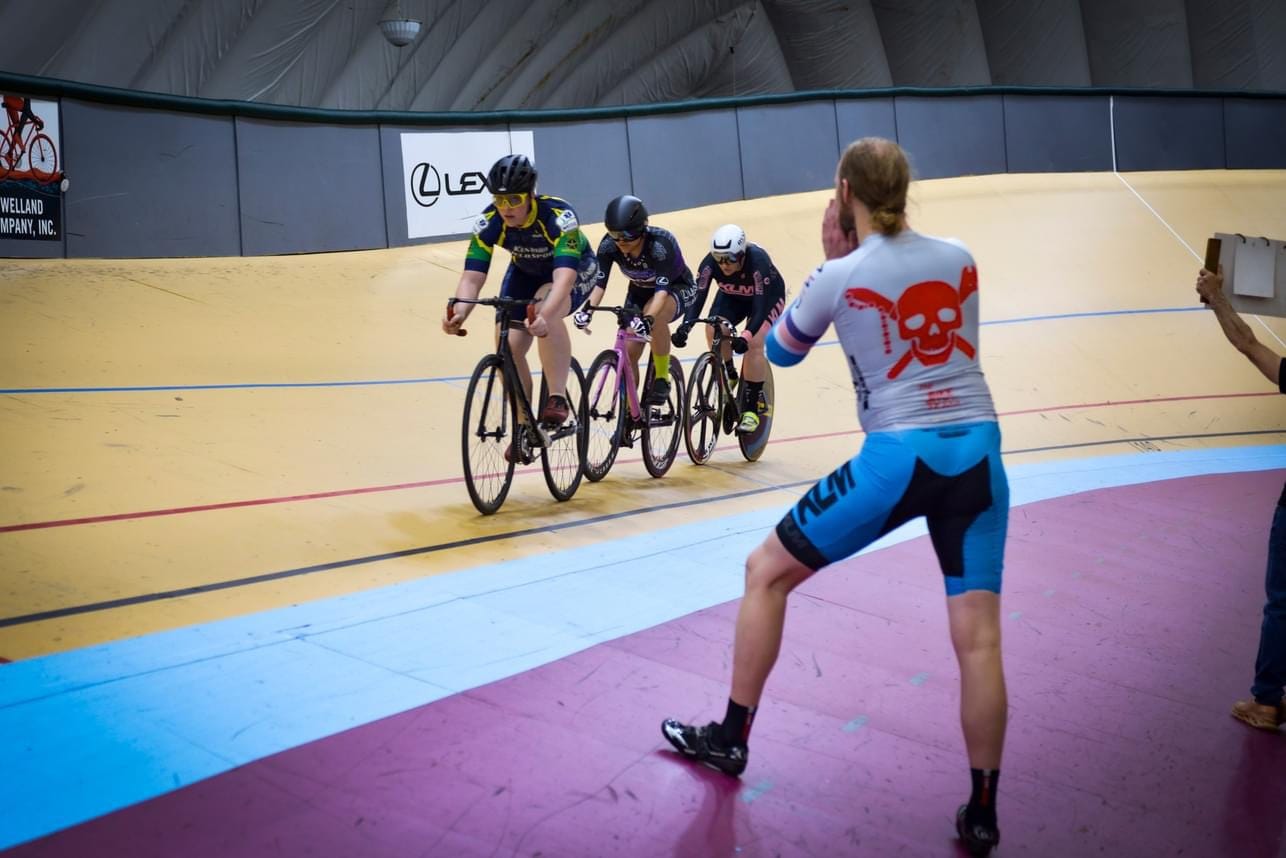
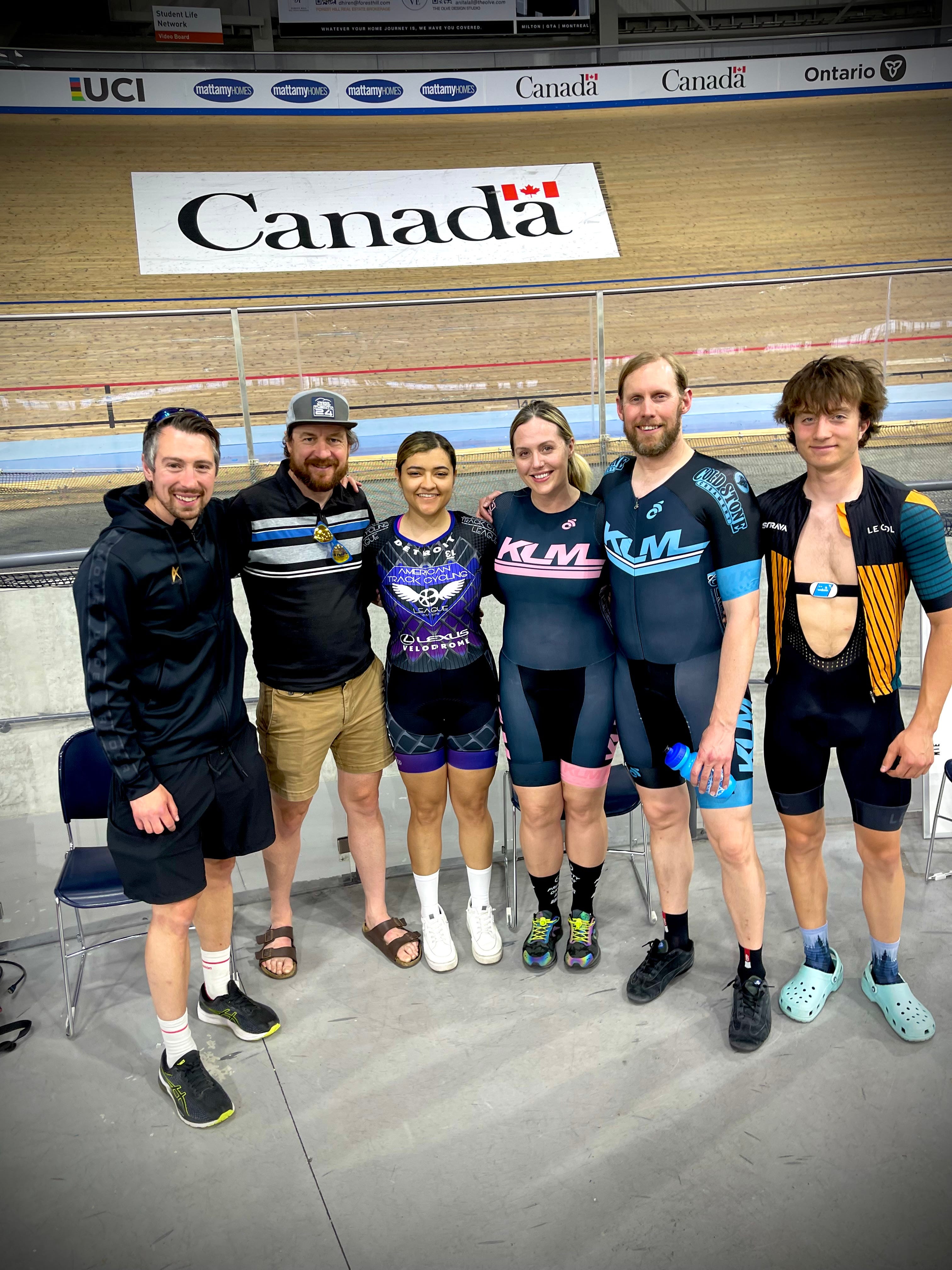
This was Milton, up in Canada, a mixed field. Amanda and I were the only two women in the heat.
I drew into third wheel, mid-pack, which I like. You can see the front from there, and you’re not doing any work to be there. We’re rolling behind the derny, and I’m watching the guy in second, and he opens a gap. A big one. Bigger than you’d open on purpose.
I read that as him about to rush — you open a gap so you’ve got runway, so when you go you’re already moving. Fine. So I opened a little gap of my own, because if he’s going, I want room to answer him.
He didn’t go.
He just sat there in all that space, and I’m pretty sure what he actually wanted was for me to come around him so he could drop into my wheel and sit third. Which is a fine plan, if the person in front of you cooperates.
So now I’ve got a gap open and a decision to make in about a second and a half, and the derny pulls off, and I can see the guy on the front doesn’t want it either. He’s not going. The pace sags. It’s a slow entry — the field hesitates, and hesitation at that moment is an opening.
Two riders in front of me, neither one willing to lead. And me with a runway already built.
I went on the corner.
You’re not supposed to pass on a corner. I ride at the MAD Track in Detroit, where the banking is so steep that you learn to use the corners to move — you carry the bank, you let it throw you, you come out of it with speed you didn’t have to make yourself. Milton is bigger and shallower, and it is not my home track, and I used the corner anyway, as a slingshot, and came out of it into the straight and put myself on the front.
Three of us went. The guy who’d opened the gap and the last rider couldn’t come with it, and just like that they were gone, and it was me, Amanda on my wheel, and the man who’d been sitting on the front.
Then I got what I asked for.
Amanda was on my wheel so tight it’s almost funny to watch on the video. She was going to ride there the whole way and come around me at the end. That was the correct race for her to ride and I’d have ridden it too. Meanwhile, the guy behind her worked out the same thing and got on her wheel, and then started creeping up alongside, so we were stacked three high coming through the turns.
I was on the black line. I was on a 112-inch gear, and my legs were on fire, and I was trying to hold a cadence I had no business holding, because I knew exactly what both of them were doing. They were resting. In my draft. Waiting.
I led it for a full lap like that. Two people getting a discount off my effort, and me paying full price, and the finish still a long way away.
We came into the last corner, and I had nothing. That’s not modesty; there was nothing there. Milton is a bigger track than I’m used to, and the straight in front of me looked absurd, and you don’t look back when you’re racing, but you don’t have to — you can feel them. I felt them coming up.
And what showed up in my head was Coach Joe Maloy.
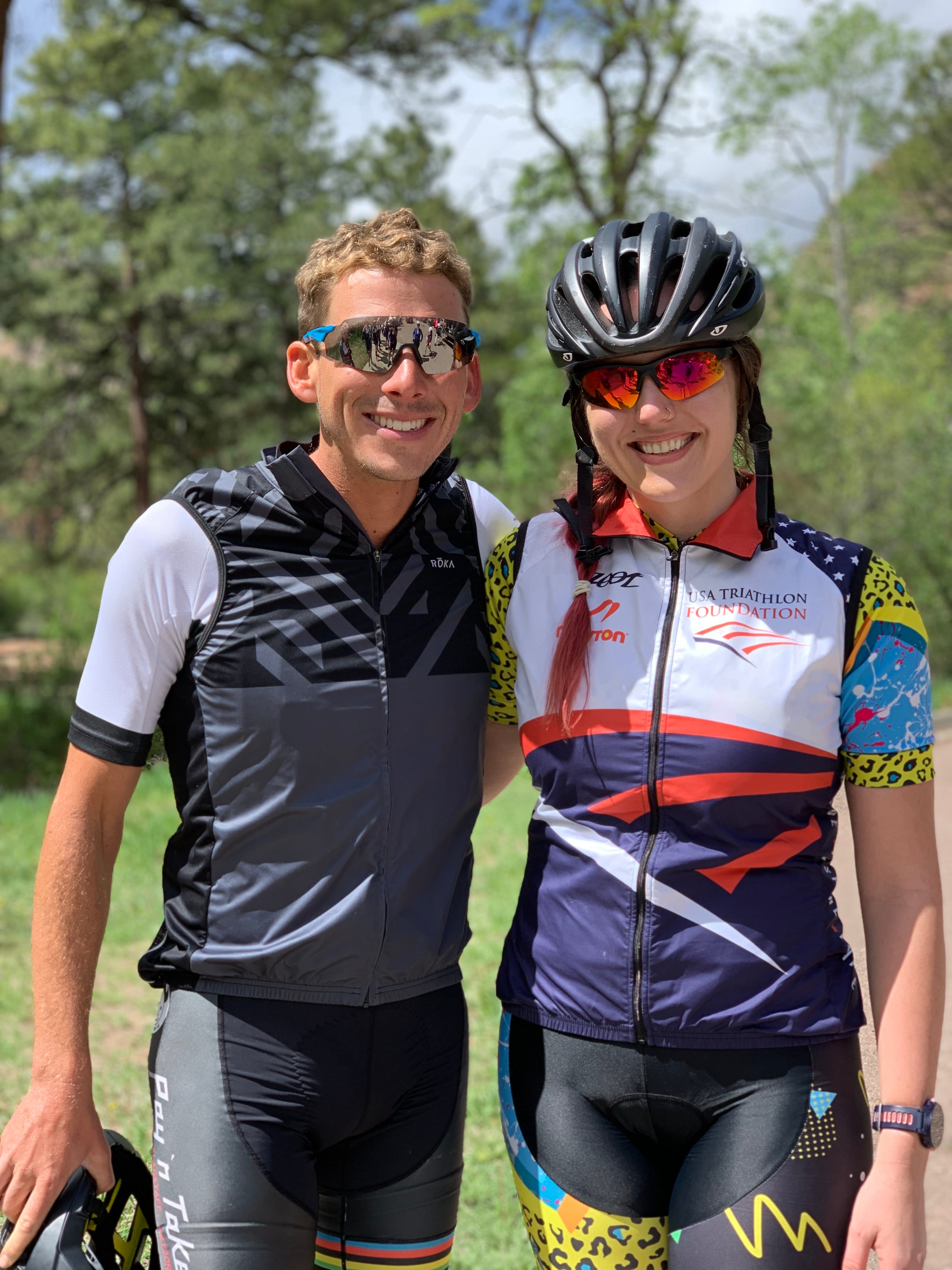
He coached me during my USA Triathlon Foundation days, and he’s one of the more remarkable people I’ve been lucky to learn from. I once ran an eight-minute mile next to him while he held a cup of coffee and carried on a conversation, as if we were standing in a kitchen. I was completely gassed. He was fine. He was always fine.
What he used to tell me was: go hard, and then pick it up some. —Coach Joe Maloy.
Which is a ridiculous thing to say to someone who is already empty, and it’s also the only thing that works, because it doesn’t ask you to find something you have. It asks you to go anyway.
So I picked it up. Out of legs, out of air, on a gear that was too big, with two riders coming off my wheel fresh.
I won by inches… maybe.
I want to be precise about what that was, because it would be easy to sell it as something cleaner than it was.
I did not win that race efficiently. I won it, having done every bit of the work while two people rested behind me, and the margin was nothing; if the line had been ten meters further out, I don’t know. That’s the honest version.
It started slow, and it did not stay slow. It opened at a crawl, everybody looking at each other, and by the end I was doing about 49 kilometers per hour — which is a real sprint, and I was making every bit of it myself while two people sat behind me spending nothing.
But here’s the thing I keep coming back to. Everyone in that race got the same information at the same moment — the derny pulls off, nobody wants the front. The other five did the sensible thing, which is wait. Waiting is genuinely smart. Waiting is the percentage play. And waiting is also how you end up finishing behind someone who had worse legs than you and went anyway.
There’s no version of that race where I sit in and win. I was not the fastest person on the track. What I had was that I’d read it early, opened a gap before I needed it, and then committed and refused to renegotiate.
Because that’s the other half, and it’s the half that actually hurts. Once you go, you cannot look back. Not literally — looking back on a bike costs you speed, and it tells everyone behind you exactly how you’re feeling. But also not in your head. The moment you start relitigating whether going was the right call, you’ve stopped riding and started auditing, and the audit is slower than the ride.
This Friday will be my fourth week into working for myself, and it is the same event.
Nobody is taking a pull for me. There’s no order, no rotation, no one whose job it is to be in the wind while I recover. Every meeting I get, I made. Every bit of speed there is, I’m making it. And there are people watching from a comfortable position who will tell me later what they’d have done differently, and some of them will be right, and none of them are out here.
The work has become a keirin for a lot of us. The positions dissolved, the alliances are temporary, and there is no rotation coming. That’s not a complaint; it’s just the event we’re in now. And the event rewards different things than the one we trained for. It rewards reading it early. It rewards opening the gap before you need it. It rewards going when the people in front of you won’t, and then not asking yourself about it again until after the line.
You will not win pretty. I didn’t.
In August of 1983, Doug Rader, then managing the Rangers, took a shot at the White Sox — they weren’t good; they just won ugly. Chicago put it on the wall. They took the division by twenty games.
I love that story, but not for the comeback. I love it because “winning ugly” is the only honest description of what this actually looks like day to day, and nobody tells you that part.
Here’s what nobody tells you. You will have weeks where you cannot see a single piece of evidence that you’re winning. And that is not because you aren’t. It’s because the machinery that used to show you is gone.
You had a standup. You had a weekly. You had a board with your name on cards moving left to right, and a manager whose actual job included telling you how you were doing, and a review cycle that forced somebody to write it down twice a year. None of that measured your worth, but all of it measured your motion, and you got used to motion being visible without having to make it visible yourself.
Now you’re doing six things at once, and none of them report to you. The consulting work, the writing, the thing you’re building, the money, the body, the people you owe a call. Progress is happening in all of them, and it’s happening slowly and in different directions, so on any given Thursday it feels like nothing. You are not failing. You just took away the instrument panel, and you’re flying by feel, and feel is a terrible instrument.
So build the panel again. You already know how.
This is the part I want to be blunt about, because I think a lot of people leaving tech throw away the most useful thing they own. You spent ten years learning how to make ambiguous work legible. You know how to break something enormous into tickets. You know how to write acceptance criteria so you can tell whether a thing is actually done or just feels done. You know what a roadmap is, and a milestone, and a definition of ready, and you know how to run a retro on yourself without turning it into self-flagellation. That skill was never the company’s. It was always yours. You just only ever pointed it at someone else’s goals.
Point it at your own.
Athletes already know this, which is why I keep both languages. A training plan is a roadmap. A block is a sprint. A goal race is a milestone. You don’t train by going out and riding hard whenever you feel like it — you’d get slower and hurt. You build blocks, you set a target, you write it down before you start, and then you do the work on the days you don’t feel like it, which is most of them. Nobody thinks that’s ugly. It’s just training.
So write yourself the plan. Give the week a shape before the week arrives. Decide what “done” means for each thing you’re carrying so you can actually cross something off instead of ending every day with a vague sense of debt. Look at it on Sunday. Be honest about what moved and what didn’t — genuinely honest, not the version where you’re either a hero or a fraud.
And accept the part that took me longest. This is not a nine-to-five anymore. There is no whistle. The work will take exactly as much of your life as you let it, so you have to build the container yourself, including the parts where you stop. That’s not a lifestyle-design thing. That’s the job now.
You might decide you want to go back. That’s a completely legitimate choice, and I’m not going to pretend otherwise — a real team, a real rotation, someone else in the wind sometimes. There’s nothing weak in wanting that.
But if you’re staying out here, this is what winning looks like. It looks like a plan you wrote for yourself, on a Tuesday, that nobody will ever review. It looks like doing the day’s work with nothing on the scoreboard. It looks like slow, invisible, unglamorous accumulation that only becomes obvious in hindsight.
It looks ugly. It’s still winning.
Legs burning, nobody pulling, doing all the work with people in my draft.
I decided to take a risk and placed a bet on myself to win. You can too! Still ahead at the line.
Keep going.
— Lyndze